
What Tartan Looks Like in Scotland’s National Book Town
Wigtown in festival season has a rhythm unlike Scotland's Highland Games towns.
People move through the square with books tucked under their arms. Conversations begun after an author talk continue outside the County Buildings. The Festival Marquee occupies the gardens, temporary venues appear around town, and seventeen bookshops and book-related businesses give visitors plenty of reasons to miss whatever they had originally planned to attend next.
For ten days in 2026, from 25 September to 4 October, Wigtown Book Festival brings more than 250 events to this small corner of Dumfries and Galloway. The programme ranges across novels, poetry, politics, history, nature, film, theatre, music, podcasts, guided walks and workshops. Wigtown itself has held the title of Scotland's National Book Town since 1998.
It is not an event built around Highland dress.
That is precisely why wearing a kilt here can be interesting.
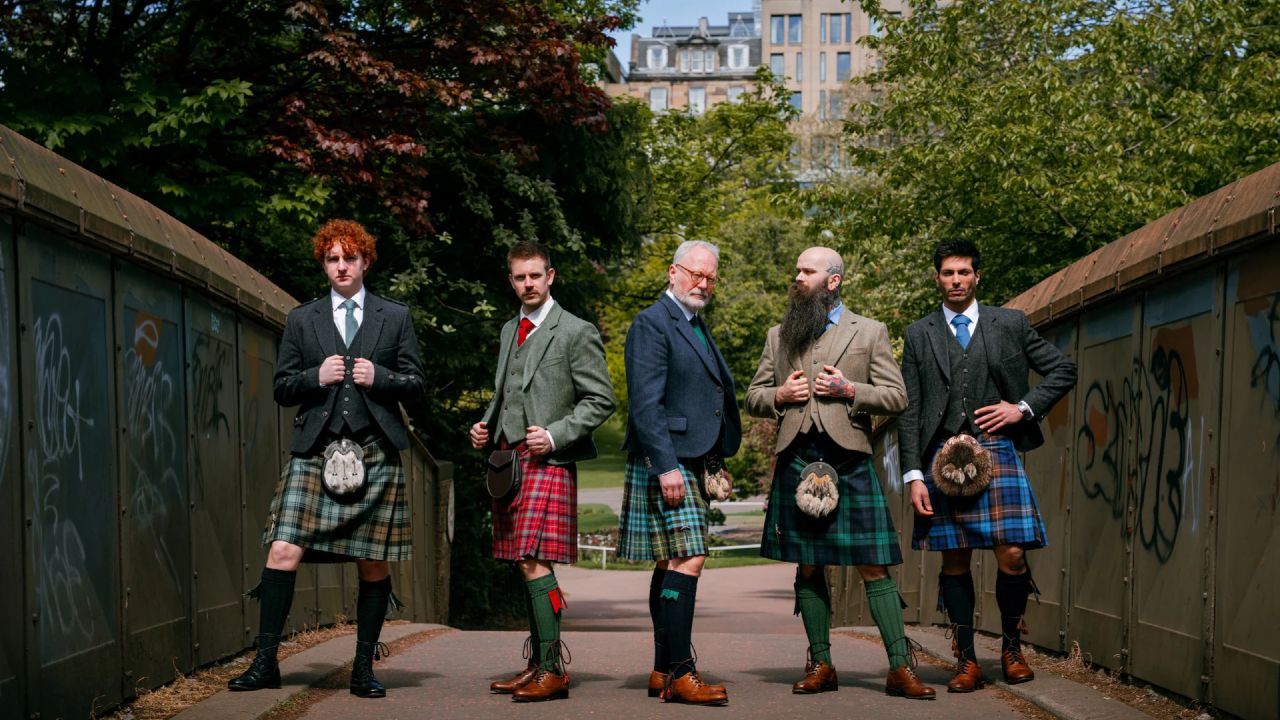
A tartan kilt at Wigtown does not need to imitate a piper, dancer or Highland athlete. Instead, it can sit within the broader cultural Scotland represented by the festival: a country of regional identities, languages, migration, storytelling, old traditions and new interpretations.
At Wigtown, books tell those stories explicitly.
Tartan can carry some of them without saying a word.
Wigtown Sits in a Scotland That Is Easy to Overlook
When people abroad imagine Scotland, the mental geography often moves north almost immediately.
The Highlands. Glencoe. Skye. Loch Ness. Cairngorms. Highland cattle against mountains.
Wigtown offers another Scotland.
It lies in the Machars of Dumfries and Galloway in the south-west, surrounded by green fields, coastline, moorland and hills. The festival itself describes the region as lying between central Scotland and Ayrshire to the north and Cumbria and the Lake District to the south.
This matters to a discussion of Scottish clothing because tartan has long escaped the geographic boundaries suggested by the word "Highland."
The kilt has Highland origins, certainly. But its later history brought it into military service, ceremonial clothing, national symbolism and civilian Scottish dress far beyond the Highlands themselves.
Today you can wear a traditional tartan kilt in Wigtown without pretending that Dumfries and Galloway is somehow part of the Highlands.
The distinction is worth keeping.
Scottish culture becomes more interesting when its regional differences are preserved rather than flattened into one image.
 Harvey Tartan Kilt for MenSpecial Price $299.00 Regular Price $515.00


Books Helped Wigtown Cross a Different Kind of Border
The town had to reinvent what it was known for
The modern Wigtown story begins with economic trouble rather than literary glamour.
By the mid-1990s, the former county town of Wigtownshire was struggling. Properties stood empty or deteriorating, unemployment was high, and even the County Buildings faced an uncertain future.
Then came the idea of creating a Scottish "book town."
Six communities entered the competition: Wigtown, Gatehouse of Fleet, Moffat, Dalmellington, Dunblane and Strathaven. An international panel selected Wigtown, and on 16 May 1998 it became Scotland's National Book Town. The first book festival followed as part of the plan to use books and cultural tourism to revive the local economy.
More than a quarter-century later, the effect is visible throughout town.
Wigtown now has seventeen bookshops and book-related businesses operating throughout the year. During the autumn festival, the town centre itself becomes the venue, with the County Buildings, gardens, bookshops, tents and other spaces hosting events.
That transformation offers an unexpectedly useful way to think about traditional clothing.
Tradition survives best when people find new reasons to use it.
Wigtown did that with books.
Scotland has repeatedly done something similar with tartan.
The Kilt Has Crossed More Borders Than Most Scottish Clothing
Geography was only the beginning
A kilt can carry a remarkable number of associations.
For one wearer, the tartan may connect to a clan surname.
For another, it represents a district.
Someone else may wear Black Watch because of its military history. Another person may choose a universal tartan without claiming any ancestral association whatsoever.
Then there are Scots and people of Scottish descent living in Canada, the United States, Australia, New Zealand and countless other places where Highland Games, Burns societies, pipe bands and Scottish cultural organisations have kept elements of traditional dress alive.
Tartan travelled with people.
Eventually, people without Scottish ancestry began wearing it too.
That movement across borders is not necessarily a weakening of the tradition. Cultural clothing has rarely survived by remaining untouched in one place.
The important distinction is between participation and invention.
You can appreciate tartan without fabricating a clan connection. You can wear a kilt without pretending to be a Highlander. You can learn the history of the garment while still combining it with contemporary clothes.
Wigtown, with writers and audiences arriving from Scotland and overseas, is a particularly suitable place for that broader interpretation of Scottish dress. The 2026 festival itself brings together local, national and international voices across more than 250 events.
Your Tartan Does Not Need a Family Tree Attached
The clan system dominates modern tartan shopping so completely that newcomers can assume they need a Scottish surname before buying a kilt.
They do not.
If you genuinely have Scottish ancestry, researching it can make choosing a tartan far more rewarding. Find out where the family actually lived. Trace surnames through records rather than internet lists alone. Investigate whether the family has an established association with a clan, district or recognised tartan.
But accept whatever the research tells you.
If no clear clan connection emerges, that does not leave you without options.
Universal tartans exist precisely because not every tartan is restricted by family association. District tartans connect with places. Military patterns have their own histories. Contemporary tartans can commemorate organisations, communities or events.
Kiltist's wider range of kilts for men gives you room to approach the decision through colour, history and intended use rather than treating a surname as the only possible starting point.
At a literary festival, that attitude seems especially appropriate.
Good history occasionally complicates the story we hoped to find.
It is still better than fiction presented as fact.
Black Watch Works Particularly Well in Wigtown
Some tartans are easier to move beyond formal Highland dress
If you want a traditional kilt that does not dominate a literary-festival outfit, Black Watch is difficult to beat.
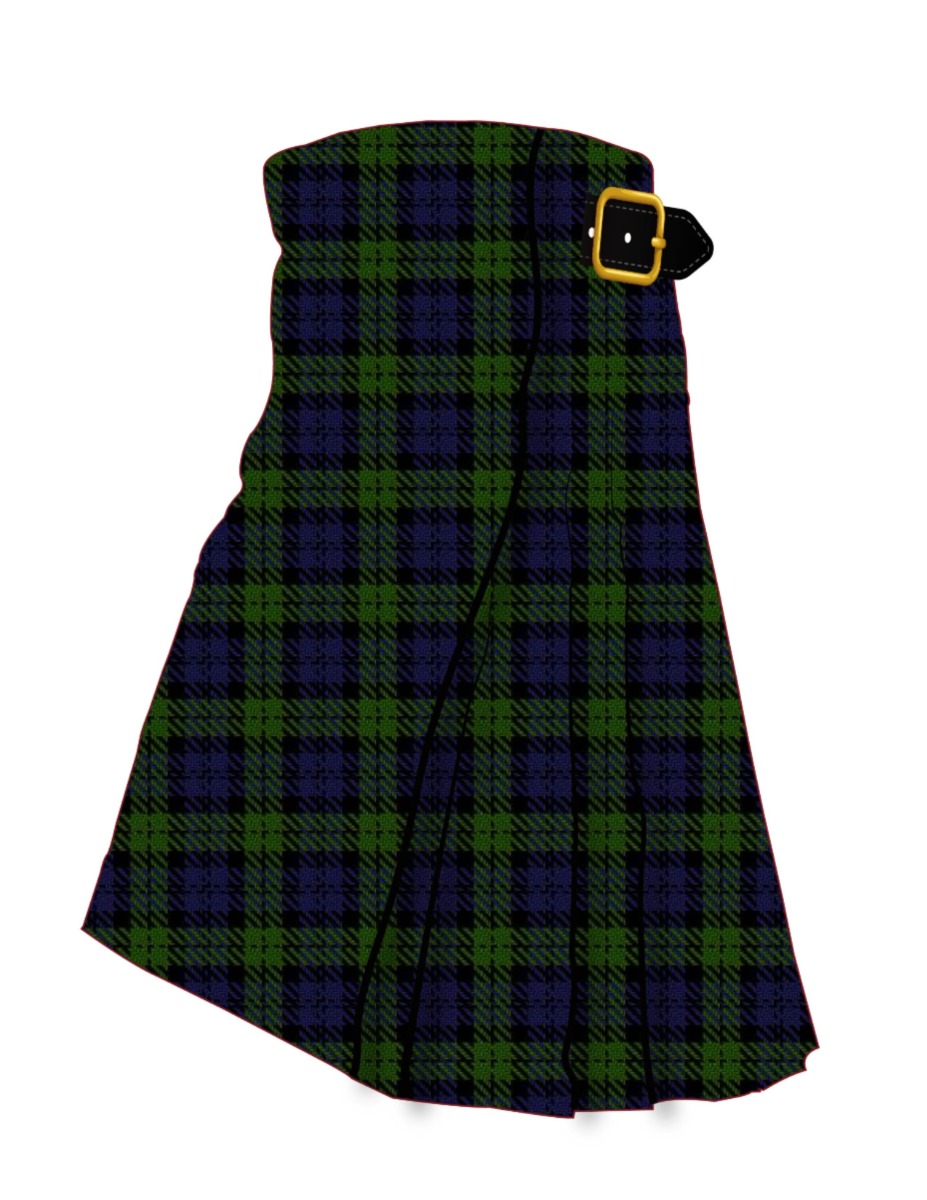
Its familiar dark blue and green sett has a long military association, but its restrained palette also makes it unusually versatile in civilian clothing. It can sit beside navy knitwear, a cream shirt, dark leather, grey wool or a quiet tweed without creating too much visual competition.
The Black Watch Smallest Sett Tartan Kilt is particularly useful for this sort of outfit because the close repeat gives the tartan plenty of character without making the entire look depend upon large blocks of colour.
That matters in Wigtown.
You are not dressing for a parade.
You may be sitting in the Main Hall during one event, browsing a second-hand bookshop half an hour later and walking through the gardens before the next talk.
The kilt should belong to all three settings.
Wigtown in Late September Calls for Layers
This is where traditional cloth meets ordinary Scottish weather
The 2026 festival begins on 25 September and continues into 4 October.
That means autumn dressing.
Instead of building the outfit as though the kilt requires a complete Highland uniform, start with what you would sensibly wear during a changeable autumn day in south-west Scotland.
A shirt.
A knit.
Perhaps a wool jacket.
Something waterproof within reach.
Then add the kilt.
This produces a much more convincing Wigtown outfit than beginning with every item in a formal Highland package and trying to remove pieces until it becomes casual.
A dark tartan looks particularly good beneath textured knitwear. Cream, charcoal, navy, brown and forest green are all easy colours to work with depending on the sett.
If rain arrives, wear a coat.
Traditional dress does not become more authentic because its owner refuses to dress for the weather.
Tartan and Tweed Need a Little Restraint
There is something almost irresistible about combining tartan and tweed at a Scottish literary festival.
And it can work beautifully.
A dark tartan kilt beneath a brown, grey or green tweed jacket feels completely at home among old bookshops, stone buildings and an autumn landscape.
But both fabrics have visual character.
The safest approach is to let one provide pattern and the other provide texture.
If the tartan has a large, colourful sett, choose a relatively quiet tweed. If the kilt is dark and restrained, the jacket can carry a little more variation.
Avoid large checks fighting large checks.
The goal is not to look like every Scottish textile sample was attached to the same person.
Good Highland clothing often becomes more convincing when something is deliberately left out.
What Goes Above the Kilt at Wigtown?
Almost anything simple enough to let tartan breathe
A plain Oxford shirt is probably the easiest choice.
White and cream work with almost everything. Pale blue suits many blue and green tartans. Charcoal or black can make brighter setts feel more contemporary.
A grandad-collar shirt also works well if you want something less formal.
For an outfit that leans further into Highland dress, one of Kiltist's ghillie shirts can be worn without a jacket. The open lace neckline gives the outfit a recognisably Scottish character while remaining much more relaxed than formal Highland evening wear.


Then there is knitwear.
A simple crew neck over a shirt can make a tartan kilt feel remarkably ordinary in the best possible sense.
You stop looking dressed for an occasion.
You simply look dressed.
That is exactly right for Wigtown.
A Sporran Is Useful Until You Buy the Third Book
There is a practical problem with wearing a traditional kilt around a book festival.
No trouser pockets.
Fortunately, Highland dress solved that problem a long time ago.
A simple leather sporran is ideal for Wigtown. It can hold a phone, wallet, cards, keys and perhaps the printed notes for whichever events you have booked.


 Blue Calfskin Dress SporranSpecial Price $69.00 Regular Price $110.00
 Brown Embossed Leather SporranSpecial Price $55.00 Regular Price $75.00


Then you enter a bookshop.
One book becomes two.
Two become four because one of them was out of print and another has a beautiful old dust jacket.
At that point, centuries of Highland clothing offer no further assistance.
Bring a tote bag.
It is one of those rare accessories that somehow looks completely natural with both a kilt and a literary festival.
The Festival Is Bigger Than Books Alone
Calling Wigtown a book festival is accurate, but increasingly incomplete.
The 2026 programme includes more than 250 events spanning literature, poetry, film, theatre, music, podcasts, guided walks, panel discussions and workshops. There are programmes for younger readers and families, and the festival also holds a ceilidh.
That variety makes the kilt easier to wear.
You are not spending ten hours silently seated in lecture rooms.
A day can move between intellectual, social and outdoor settings. Evening entertainment changes the atmosphere again.
If your schedule includes the ceilidh, the argument for wearing a kilt becomes even easier.
Just make sure it fits properly before attempting anything energetic.
Fit Is Still the Difference Between Clothing and Costume
A casual outfit does not excuse a poorly fitted kilt.
Traditional kilt proportions are quite different from ordinary trousers.
The waistband normally sits around the natural waist rather than low on the hips. The front aprons should lie flat. Pleats occupy the rear and need enough room across the seat to hang properly. The hem traditionally falls around the middle of the knee when standing.
That structure gives the kilt its silhouette.
Wear it too low and it begins looking like an unusually long tartan skirt.
Wear it too short and the proportions become immediately obvious.
This is why jeans size alone is not enough when ordering a made-to-measure kilt. Measure the waist where you actually intend the kilt to sit, then take the hip and length measurements carefully.
The simpler the rest of your Wigtown outfit becomes, the more important that clean fit becomes.
Boots May Make More Sense Than Ghillie Brogues
Ghillie brogues are traditional and can look excellent.
They are not compulsory.
Wigtown's festival venues spread through the town centre and into the wider local area, so visitors regularly move between buildings, tents, gardens and bookshops. Add autumn weather and a comfortable pair of leather boots begins making a very persuasive case.
Brown boots work beautifully with green, blue and earthy tartans.
Black leather suits darker setts.
Ordinary brogues occupy the middle ground if you want something smarter without adopting full Highland footwear.
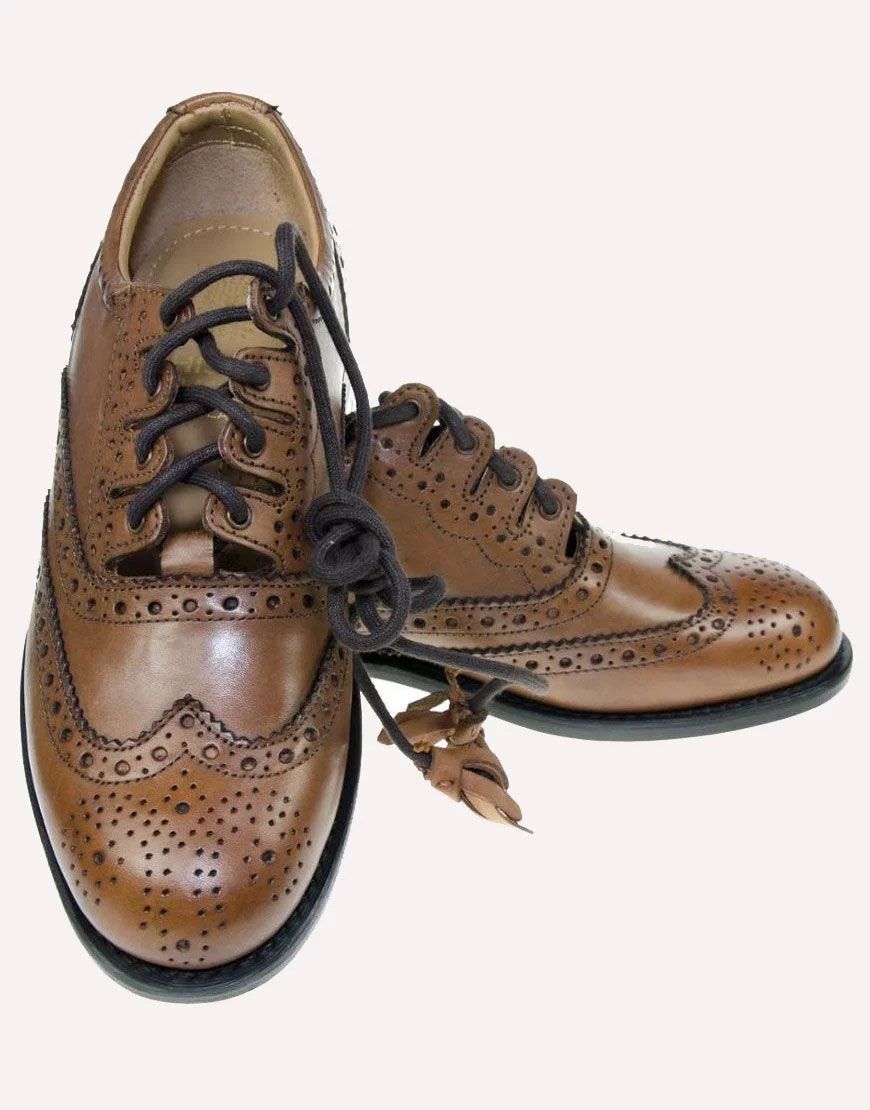
If you do prefer traditional shoes, Kiltist's Brown Leather Ghillie Brogues can complete a more recognisably Highland combination.
Whichever direction you take, choose shoes you can walk in for hours.
Wigtown encourages wandering.
Where an Argyll Jacket Fits Into the Story
A daytime literary festival rarely requires formal Highland dress, but some people will want a smarter outfit for evening events, dinners or social occasions.
This is where the Argyll jacket becomes useful.
Unlike Prince Charlie dress, which is strongly associated with formal evening Highland wear, an Argyll jacket can move between day and evening far more easily.
A Black Argyll Men's Scottish Kilt Outfit gives you the traditional structure of a jacket, waistcoat and kilt without immediately pushing the outfit into black-tie territory.
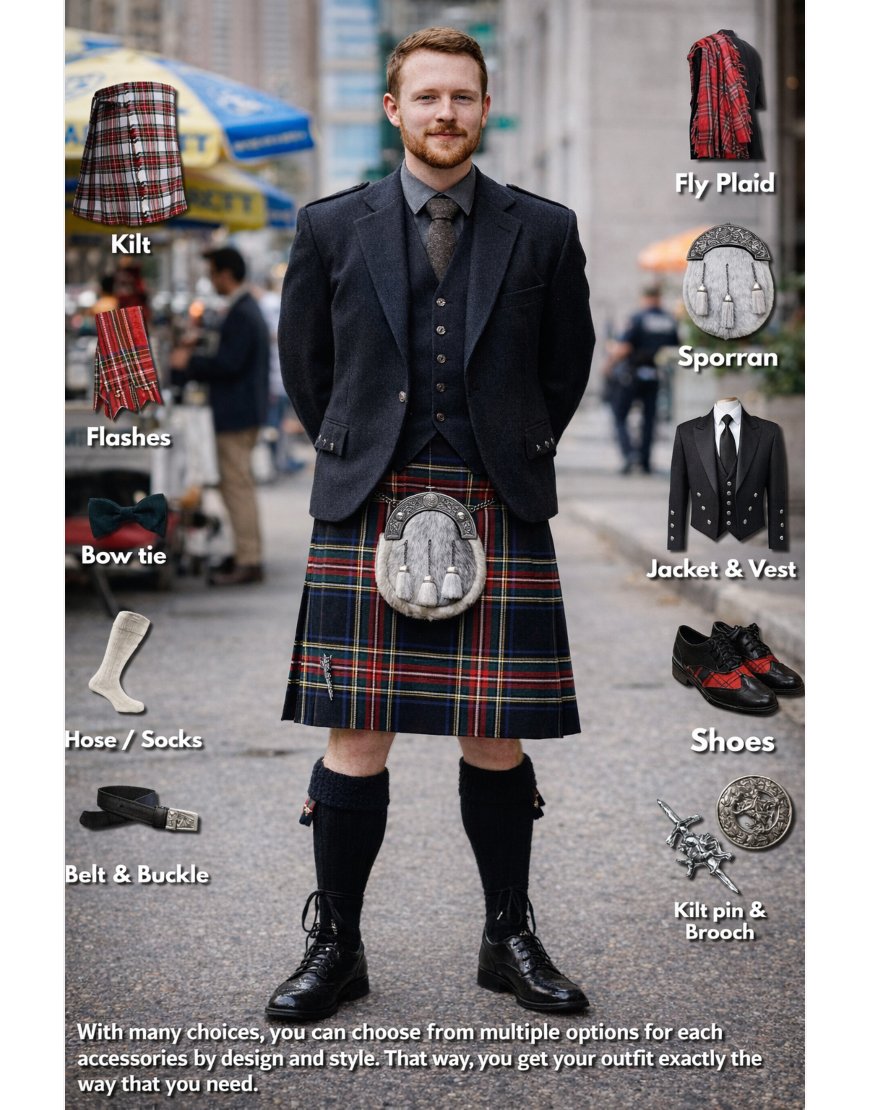
A Light Grey Argyll Jacket Kilt Outfit Package creates a softer alternative, particularly with darker tartans.
But neither is necessary for an ordinary afternoon of author talks.
Sometimes a sweater is the better jacket.
Cultural Dress Does Not Mean Dressing as a Historical Character
This becomes particularly important at an event concerned with culture and history.
Wearing traditional clothing does not require pretending to live in another century.
You do not need a bonnet simply because you are wearing tartan.
You do not need a fly plaid for a book signing.
You do not need military insignia unless you have a legitimate reason to wear it.
And you certainly do not need to introduce yourself through an elaborate clan story assembled from an online surname search the night before.
The kilt has survived because it adapted.
It can be worn with contemporary knitwear, modern outerwear, ordinary leather boots and a canvas book bag while remaining recognisably a kilt.
That is not disrespecting tradition.
It is one of the ways tradition remains alive.
Books and Tartans Both Carry Names
There is another small connection between Wigtown and tartan that becomes apparent after spending time with either.
Names matter.
Book covers carry authors' names, titles, publishers and editions. Those details tell you something about where a text came from and how it reached you.
Tartans carry names too.
MacDonald.
Campbell.
Stewart.
Black Watch.
Districts, regiments, institutions and commemorative designs.
But in both cases, the name is only the beginning.
Owning a book does not mean understanding it.
Knowing the name of a tartan does not mean knowing its history.
A little curiosity changes the experience.
Research who registered or documented the tartan. Understand whether it is a clan, district, military or universal sett. Learn why alternative colourways exist. If it is associated with your family, find out whether the genealogical connection actually holds.
The fabric becomes more interesting once you know what you are looking at.
Wigtown Is Proof That Culture Can Be Reused Without Being Cheapened
Perhaps the strongest connection between books and kilts at Wigtown is not visual at all.
It is the way both survive.
Wigtown did not preserve itself by becoming a museum of a declining market town. It used an old cultural object, the printed book, to create a new economic and social identity.
The result was Scotland's National Book Town.
The festival now brings a substantial audience into a community of around a thousand people, while its permanent bookshops keep that identity alive outside the festival dates.
Traditional clothing works in much the same way.
If kilts were worn only during historical reenactments, their cultural life would become very narrow.
Instead, people continue wearing them at weddings, Games, ceilidhs, dinners, festivals, concerts and ordinary social occasions.
Wigtown can be one of those occasions.
A Simple Wigtown Outfit Is Hard to Beat
If you want one combination that will carry you through most of the festival, keep it straightforward.
Start with a dark or moderately coloured tartan kilt. Add a plain shirt and a wool knit if the weather requires it. Wear neutral hose with a simple day sporran. Choose comfortable leather brogues or boots. Carry a waterproof outer layer and a bag for books.
That is it.
For a smarter evening, replace the knit with an Argyll or tweed jacket.
For the ceilidh, remove whatever layer will make you regret dancing after the first set.
The same kilt can remain throughout.
That versatility is part of the point.
Final Thoughts
Wigtown is a useful reminder that Scottish culture does not exist in separate boxes.
Literature does not belong only in libraries.
Tartan does not belong only at Highland Games.
Traditional clothing does not have to become costume.
And a small town does not have to accept the identity history happened to leave it with.
Wigtown became Scotland's National Book Town in 1998 after a period of serious economic difficulty. Today its seventeen bookshops and annual festival draw readers, writers and visitors to south-west Scotland, while the 2026 festival alone offers more than 250 events over ten days.
A kilt fits comfortably into that setting because it carries a similar mixture of inheritance and reinvention.
Wear your family tartan if you genuinely have one. Choose a district or universal sett if that makes more sense. Pair it with a sweater, tweed jacket or ordinary autumn coat. Put your phone in the sporran and your books in a tote.
Then forget about whether the outfit is Scottish enough.
Spend the day listening, reading, arguing, browsing and discovering something you did not know before.
For a festival built around stories, that is a much better use of tradition than simply dressing the part.