
Where Highland Sport, Perthshire Tradition, and Personal Tartan Meet
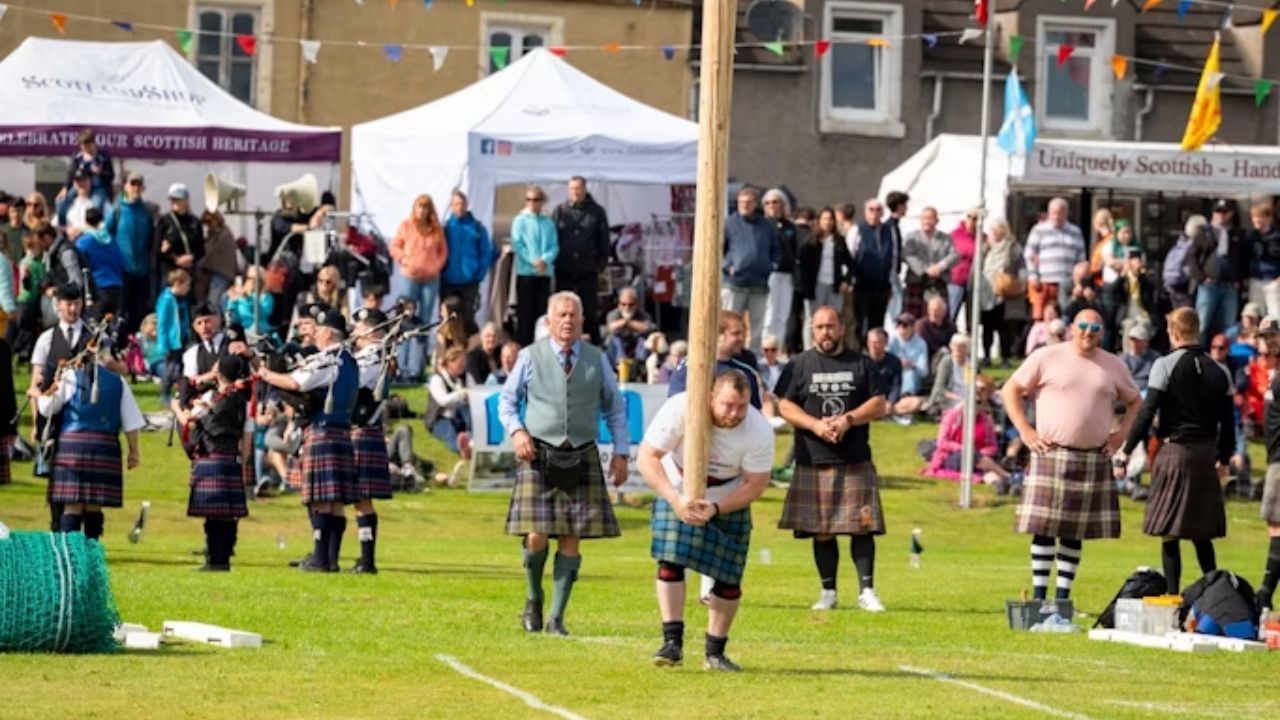
A caber turns through the air. A hammer lands beyond the marker. Highland dancers compete nearby while pipers prepare for the day's music. Later, bands gather for the massed pipes and drums. Across the field, competitors and spectators wear tartans carrying military, family, district, and personal associations.
This is Crieff Highland Gathering.
The Gathering has roots stretching back to 1870 and remains one of Scotland's established traditional Highland Games. Its programme brings together heavy athletics, running, cycling, piping, Highland dancing, tug of war, parades, and ceremony. For the 2026 Gathering, held on 16 August at Market Park, these traditions once again meet in a single Games day.
The kilt belongs naturally within that mixture. Its history connects physical Highland life with military service, public ceremony, family identity, and the nineteenth-century development of clan tartans. For today's visitor, wearing one at Crieff can therefore mean something beyond dressing appropriately for a Scottish event.
It can connect the spectacle on the field with a much more personal question: what does your tartan mean to you?
Crieff Highland Gathering Is About More Than Sport
The competitions are only one part of a much larger Scottish tradition
Highland Games are often introduced through their most dramatic events. Caber tossing photographs understandably attract attention, while stone putting and hammer throwing provide an immediate image of Highland strength.
Crieff certainly has plenty of that.
Its heavy events include throwing the hammer, putting the stone or ball, throwing weights, and tossing the caber. The Gathering also stages its unusual Challenge Caber competition, involving a particularly formidable caber supplied from the Drummond Estate.
But concentrating entirely on athletics misses much of what makes a Highland Gathering culturally interesting.
Running and cycling share the programme with Highland dancing. Solo pipers compete during the morning. Pipe bands arrive from Scotland and abroad. The Chieftain's parade introduces a ceremonial element, and the day ends with the massed pipes and drums.
Sport, music, clothing, community, and ceremony are therefore happening together.
A traditional tartan kilt makes sense in this environment precisely because the garment also occupies several Scottish traditions at once. It can be practical clothing, formal dress, ceremonial clothing, family symbolism, or simply something worn because its owner enjoys Highland dress.
Before Clan Tartans, There Was Highland Cloth
The history is more interesting than the popular myth
One of the easiest stories to tell about tartan is also one of the least accurate: that Scottish clans have each worn their own fixed tartan since the distant Middle Ages.
The historical development was considerably less orderly.
Tartan itself is old. Woven patterns of intersecting coloured stripes existed in Scotland long before the modern clan-tartan system. Local weaving traditions, available dyes, regional preferences, and individual taste could all influence the cloth people wore.
Highland clothing also changed over time.
The large belted plaid, or féileadh mòr, provided considerable fabric that could be arranged around the body and upper torso. The smaller tailored kilt eventually became increasingly common and developed into the recognisable garment worn today.
The strong association between individual clans and particular named tartans became much more systematised later, particularly during the late eighteenth and nineteenth centuries.
That does not make clan tartans meaningless.
It simply gives them a more interesting history.
They represent the way Scottish identity developed and was recorded over generations rather than an unchanging dress code inherited intact from medieval Scotland.
How the Kilt Became Connected With Scottish Identity
Suppression, military use, and revival all influenced its story
The eighteenth century was crucial to the development of Highland dress.
After the Jacobite rising of 1745, legislation restricting Highland dress formed part of the British government's attempts to weaken elements of Highland martial culture. The Dress Act provisions associated with the Act of Proscription came into effect in 1746.
There were important exceptions, particularly for Highland soldiers serving the Crown.
That military exception matters enormously to the later history of the kilt. Highland regiments preserved highly visible forms of tartan dress while civilian Highland clothing was undergoing considerable political and social change.
The restrictions were repealed in 1782.
During the decades that followed, Highland clothing underwent a remarkable transformation. What had once been viewed by the British state with suspicion increasingly became incorporated into romantic ideas of Scotland, military prestige, aristocratic culture, and eventually national identity.
By the nineteenth century, tartan was becoming one of the most powerful visual languages Scotland possessed.
That history sits quietly behind every modern Highland Gathering.
Athletics and the Kilt Share Practical Roots
Highland clothing was never invented merely for ceremony
Look at today's highly formal Highland outfits and it is easy to imagine the kilt as ceremonial clothing first.
Its origins were far more practical.
Traditional Highland clothing had to accommodate walking, physical labour, difficult terrain, and Scotland's climate. Freedom around the legs was useful in an environment where movement mattered.
This does not mean historical Highlanders were tossing cabers all day in precisely the modern kilts sold today. Highland Games themselves developed and became organised over time, while modern kilt construction reflects centuries of change.
The broader connection is more useful.
Both Highland athletic traditions and Highland dress emerged from a culture in which physical capability carried considerable importance.
At Crieff, that relationship becomes visible again. Heavy athletes compete on one side of the field while tartan surrounds the arena.
The modern spectator may be doing nothing more strenuous than walking between events, but a correctly fitted kilt remains comfortable clothing for precisely that sort of active day.
What Does Your Tartan Actually Represent?
Clan is one answer, but it is far from the only one
For someone buying a first kilt, tartan terminology can become confusing very quickly.
There are clan tartans, family tartans, district tartans, military tartans, commemorative tartans, organisational tartans, corporate designs, national tartans, fashion tartans, and universal patterns.
Then one name may appear in Ancient, Modern, Weathered, Hunting, Dress, or other colourways.
Start with the basic distinction.
A clan tartan is associated with a Scottish clan. If you have a genuine family connection to that clan, wearing its tartan can be a meaningful expression of ancestry.
District tartans connect to places rather than surnames.
Military tartans developed through regimental traditions.
Universal tartans are generally intended to be worn regardless of surname or ancestry.
This is good news for visitors to Crieff who do not have Scottish family history. You do not need to manufacture an ancestral connection simply to wear Highland clothing.
Kiltist's collection of kilts for men gives you room to compare different tartan traditions and modern kilt styles rather than assuming every wearer needs a clan sett.


If You Have Scottish Ancestry, Do Some Research First
Suppose your family tells you that your great-grandparents came from Scotland. You search your surname and immediately find a tartan attached to it.
That is a useful clue, not necessarily the end of the research.
Scottish surnames can have multiple geographic origins. Clan relationships can include branches, sept traditions, alliances, and historical associations that are more complicated than a modern surname search suggests.
Start with what you actually know.
Where in Scotland did the family live?
Which names appear in family records?
Is there a documented connection with a particular clan or district?
Does the tartan association come from a recognised historical source or merely from a retailer trying to sell you something?
If the evidence points toward a clan, wearing that tartan at Crieff can turn an enjoyable Games day into something considerably more personal.
If it does not, there is nothing wrong with choosing another established tartan because you appreciate its history or colours.
Honest interest in Scottish culture is better than invented ancestry.
Choosing a Kilt for Crieff Gathering
Buy for the years after Games Day as well
Crieff can provide the reason to buy a kilt, but it should not necessarily determine every detail of the purchase.
Ask where else you will wear it.
A traditional tartan kilt can work at Highland Games, ceilidhs, Burns suppers, Scottish weddings, St Andrew's Day celebrations, clan gatherings, and many other occasions.
That versatility makes a traditional kilt particularly useful for someone building a Highland wardrobe from scratch.
Colour deserves thought too.
Green and blue tartans are generally easy to combine with neutral shirts and leather accessories. Darker tartans can transition comfortably into evening wear. Strong red tartans create greater visual impact. Muted palettes can feel particularly natural for outdoor events.
If ancestry guides your tartan choice, colour becomes secondary.
If you have no family association, you have considerably more freedom to select a sett you genuinely enjoy wearing.
Fit Matters More Than the Name on the Tartan
A famous clan sett cannot rescue a badly fitted kilt
Traditional kilt proportions differ from ordinary trousers.
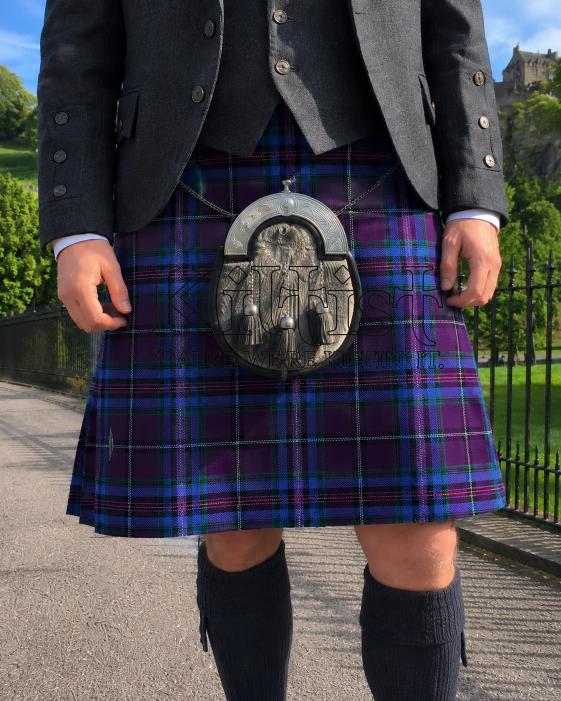
The waistband generally sits around the natural waist. The aprons lie flat at the front. Pleats occupy the rear. The hem traditionally reaches around the middle of the knee when standing.
Hip measurement matters because the pleats need to fall properly.
Length matters because even a small difference changes the overall proportions.
This is why a made-to-measure kilt can be particularly worthwhile if you expect to wear it repeatedly.
Do not simply send your jeans size and assume everything will work.
Measure where the kilt will actually sit.
For anyone assembling a complete Highland wardrobe, Kiltist's Scottish kilt outfits also show how the kilt works alongside jackets, shirts, hose, footwear, sporrans, and other components.
For Crieff itself, however, you probably need fewer pieces than a formal package contains.
 Custom Grey Watch Wedding Kilt Outfit - Timeless Elegance for Your Big DaySpecial Price $330.00 Regular Price $699.00
 Modern Prince Charlie Tartan Kilt Outfits for Formal OccasionsSpecial Price $330.00 Regular Price $514.00
 Prince Charlie Royal Stewart Kilt Outfit - Classic Formal Dress for Weddings and Special EventsSpecial Price $330.00 Regular Price $499.00
The Best Crieff Outfit Is Usually a Day Outfit
A traditional kilt does not automatically require formal Highland dress.
For a normal day at Crieff, a straightforward combination works beautifully:
A tartan kilt provides the foundation. Add a plain shirt or relaxed Highland shirt, kilt hose, flashes, comfortable leather footwear, and a day sporran.
That is already a complete Games-day look.
Kiltist's ghillie shirts are useful if you prefer the relaxed lace-neck style often associated with informal Highland occasions. A plain button-down shirt works equally well and can make the tartan feel more contemporary.


What you generally do not need is a formal Prince Charlie jacket, bow tie, dress sporran, fly plaid, and every other piece associated with Highland evening dress.
Good style depends partly on knowing the occasion.
Why a Sporran Makes Particular Sense at the Games
History and practicality happen to agree here
The sporran solves that problem while also forming one of the most recognisable elements of Highland dress.
At Crieff, practicality should determine the style.
A leather day sporran gives you somewhere for your phone, wallet, cards, and keys without introducing the heavier decoration associated with evening dress.
A semi-dress sporran can work if the rest of your outfit is slightly smarter.
Save highly ornate dress sporrans for occasions where the overall level of formality supports them.
You can compare the different approaches in Kiltist's sporran collection.
Think of the sporran as part of the outfit's hierarchy. The more casual the clothing around it, the simpler the sporran can be.
 Antique Cantle White Seal Skin Full Dress SporranSpecial Price $79.00 Regular Price $179.00


Shoes Should Survive the Gathering
There is an easy way to ruin a Highland Games outfit: wear beautiful shoes that hurt after an hour.
Crieff is an outdoor event. Expect walking, standing, grass, and plenty of time on your feet.
Traditional ghillie brogues can work very well if they fit properly and have already been worn enough to soften.
Ordinary leather brogues provide a slightly simpler alternative.
Sturdy boots can also work with more casual kilt outfits, particularly if weather conditions are poor.
The important point is that your footwear should belong to the same level of formality as the rest of your clothing while remaining suitable for the ground beneath you.
Highland dress should not prevent you from enjoying Highland Games.
The Massed Bands Bring the History Back Into View
One of the defining moments of Crieff Gathering comes when the pipe bands assemble.
The 2026 programme brought together bands from Scotland and overseas, demonstrating how far Highland musical traditions have travelled. When pipers and drummers gather in formation, tartan becomes collective rather than individual.
For regimental and pipe-band dress, consistency matters. Repeated tartan, matching jackets, hose, bonnets, and other uniform elements create visual order.
For spectators, the rules are completely different.
Your tartan can represent your family, a place, an established universal design, or simply a pattern you have chosen thoughtfully.
Seeing those two uses together is part of what makes a Gathering culturally interesting.
Uniform tartan communicates belonging to a group.
Personal tartan can communicate something about the individual.
You Do Not Need Scottish Blood to Appreciate the Tradition
Respect is more important than genealogy
Highland Games now take place far beyond Scotland.
Scottish communities and descendants carried piping, dancing, athletics, and tartan traditions to North America, Australia, New Zealand, and elsewhere. People without Scottish ancestry also attend and participate because the culture interests them.
Wearing a kilt does not require producing a family tree at the entrance.
What matters is how you approach it.
Do not claim a clan connection you do not possess. Do not treat Highland dress as a joke costume. Learn what you are wearing, choose the pieces thoughtfully, and understand the difference between civilian Highland clothing and specific uniforms or ceremonial roles.
That standard is neither complicated nor restrictive.
It simply treats Scottish culture as something worth learning about.
From Crieff to Your Next Highland Occasion
A good kilt should accumulate memories
One of the pleasures of owning a proper kilt is that it rarely belongs to only one event.
The same tartan you first wear while watching the heavy events at Crieff might later appear at a wedding. Then at Burns Night. Then at another Highland Gathering. Years later, the garment begins carrying personal associations alongside whatever historical meaning belongs to the tartan.
That is one reason choosing carefully matters.
If you are looking for your first kilt, browse Kiltist's tartan kilts with repeat wear in mind. Choose a sett you still expect to enjoy when the excitement of the coming Games has passed.


Then build around it gradually.
A good day sporran can serve numerous events. Quality hose and flashes are reusable. An Argyll jacket can be added later when you need smarter Highland dress. Formal pieces can wait until you actually have a formal occasion.
There is no requirement to build the entire wardrobe in one purchase.
Final Thoughts
Crieff Highland Gathering makes the relationship between Scottish athletics and Scottish identity unusually easy to see.
On the field, athletes put strength and technique to the test through traditions that have become synonymous with Highland Games. Around them, pipers, dancers, families, officials, and spectators maintain another set of traditions through music, ceremony, and dress.
The kilt belongs to both sides of that picture.
Its history includes practical Highland clothing, military dress, nineteenth-century cultural revival, clan associations, and the modern Scottish wardrobe. Today it can represent ancestry for one wearer and simple appreciation of Scottish culture for another.
If you have a family tartan, Crieff is a fine place to wear it.
If you do not, choose an established tartan you genuinely like, learn something about it, get the measurements right, and wear it without pretending it represents a history that is not yours.
Then turn your attention back to the field.
The caber, the pipes, the dancers, the tartan, and the crowd are all different parts of the same reason Crieff Highland Gathering has survived for generations.