
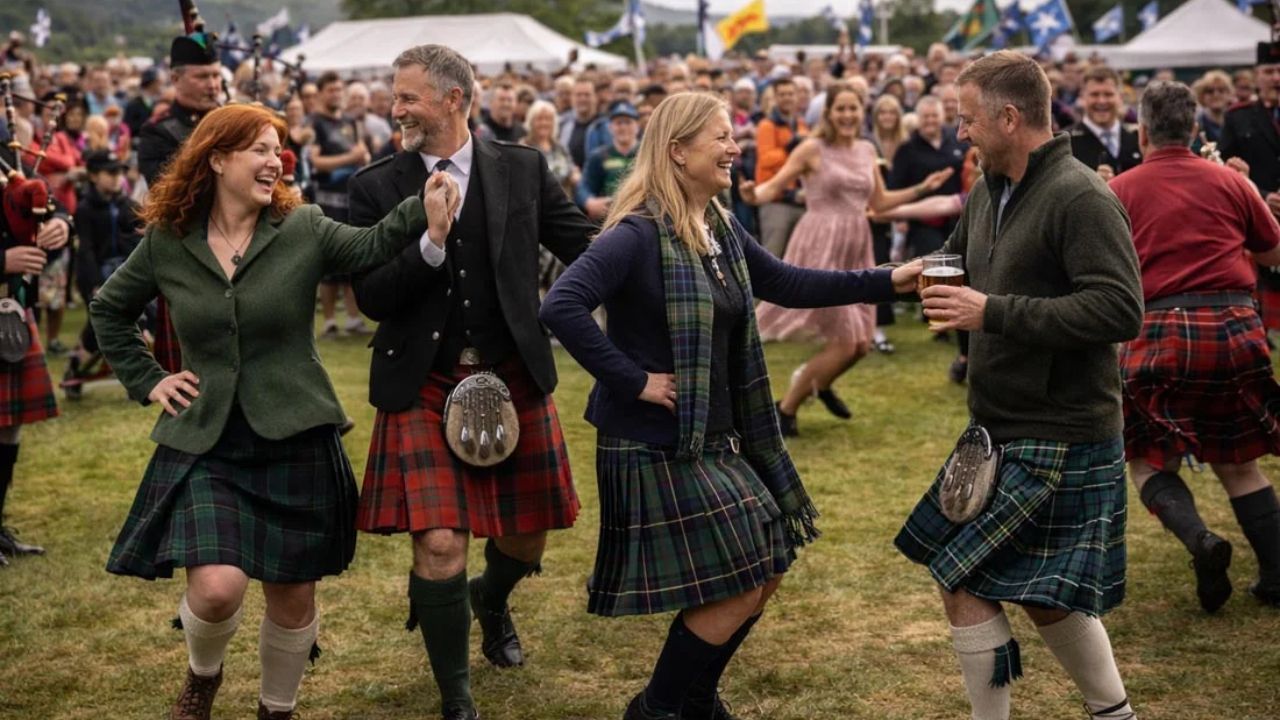
A Highland Garment in Scotland’s National Book Town
Wigtown Book Festival is not the obvious place most people first imagine wearing a kilt.
There are no cabers turning through the air. No heavy athletes waiting beside the hammer circle. No pipe-band championship filling an arena with regimental tartan.
Instead, there are bookshops.
There are author talks in halls and tents, readings, poetry, theatre, music, guided walks, debates, conversations in cafés, and people carrying newly bought books through a small Dumfries and Galloway town that rebuilt much of its identity around literature.
That difference is exactly what makes the kilt interesting here.
Wigtown became Scotland’s National Book Town in 1998, and its annual book festival developed as part of the town’s regeneration. The modern festival is a ten-day celebration that brings thousands of visitors into a community of little more than a thousand residents. The 2026 festival runs from 25 September to 4 October and features more than 250 events across literature, poetry, film, theatre, music, podcasts, workshops, and other forms of cultural programming.
In that setting, tartan does not need to represent Highland sport.
It can represent something broader: Scottish identity, literary history, personal heritage, and the ability of traditional clothing to live comfortably inside modern cultural life.
Why a Kilt Works at a Book Festival
Scottish dress does not belong only to Highland Games
One of the easiest mistakes to make with the kilt is to associate it too narrowly with a handful of occasions.
Highland Games.
Weddings.
Burns Night.
Military ceremony.
Ceilidhs.
All of those are natural places to wear one, but none of them owns the garment.
The modern kilt has become part of a much wider Scottish wardrobe. It can be ceremonial or casual, ancestral or simply aesthetic, formal or relaxed depending on how it is worn.
Wigtown provides the perfect example of that flexibility.
The festival takes place throughout the centre of town, with venues including the County Buildings, festival tents, gardens, bookshops, and other spaces across the wider area. You may spend one hour listening to a novelist, the next browsing second-hand books, then walk to a poetry event or sit outside with coffee before an evening performance.
That kind of day calls for clothing that has character without becoming cumbersome.
A well-fitted tartan kilt can do exactly that.
 Graham of Menteith Modern Tartan kilt - kiltistSpecial Price $199.00 Regular Price $314.00


Wigtown Has Its Own Kind of Scottish Heritage
Books gave the town a second life
Wigtown’s literary identity is relatively recent, but the story behind it is unusually important.
By the 1990s, the town had experienced serious economic decline, with empty and deteriorating properties and high unemployment. A national competition was launched to select Scotland’s answer to the idea of a book town, inspired by places such as Hay-on-Wye.
Six Scottish communities competed.
Wigtown won.
On 16 May 1998, it was officially announced as Scotland’s National Book Town. The designation became part of a wider effort to regenerate the town through books, tourism, and cultural events. Today, Wigtown has seventeen bookshops and related businesses, while the annual festival has become one of the best-known literary events in the country.
This story matters when thinking about dress.
Scottish heritage is not restricted to ancient traditions.
Sometimes heritage is about what a community chooses to preserve, rebuild, and pass forward.
Tartan fits remarkably well into that idea.
Literature and Tartan Share a Similar Scottish Journey
Both moved from local tradition into national identity
Tartan existed long before it became one of Scotland’s most recognisable symbols.
For centuries, woven patterns developed through local production, available dyes, regional practice, and changing tastes. The later system connecting specific tartans with clans, families, districts, regiments, and institutions grew gradually and became particularly structured during the eighteenth and nineteenth centuries.
Scottish literature followed a similarly complicated path.
Local dialects, Gaelic traditions, oral storytelling, poetry, ballads, religious writing, political pamphlets, novels, and historical works all contributed to the literary identity we now think of as distinctly Scottish.
Neither tradition remained static.
Both absorbed outside influence.
Both changed with politics.
Both travelled abroad with Scottish communities.
Both later became powerful ways of recognising Scotland visually and culturally.
That is one reason a kilt can feel surprisingly natural at Wigtown.
The event celebrates words rather than Highland athletics, but the underlying concern is similar: how does Scotland preserve a cultural identity while allowing it to keep changing?
Choosing a Tartan for a Literary Festival
The strongest option is often the quietest one
Wigtown is not a setting where you need a dramatic kilt.
You will spend much of the day indoors, sitting during talks, walking through bookshops, browsing stalls, and moving between venues.
A restrained tartan therefore works particularly well.
Dark greens, navy, charcoal, burgundy, and muted earth tones pair easily with knitwear, jackets, boots, and autumn layers. They also feel well suited to the late-September and early-October timing of the festival.
A classic choice such as the Black Watch tartan works particularly well because its navy and green palette can be treated almost like a neutral. It does not demand a formal Highland outfit around it.
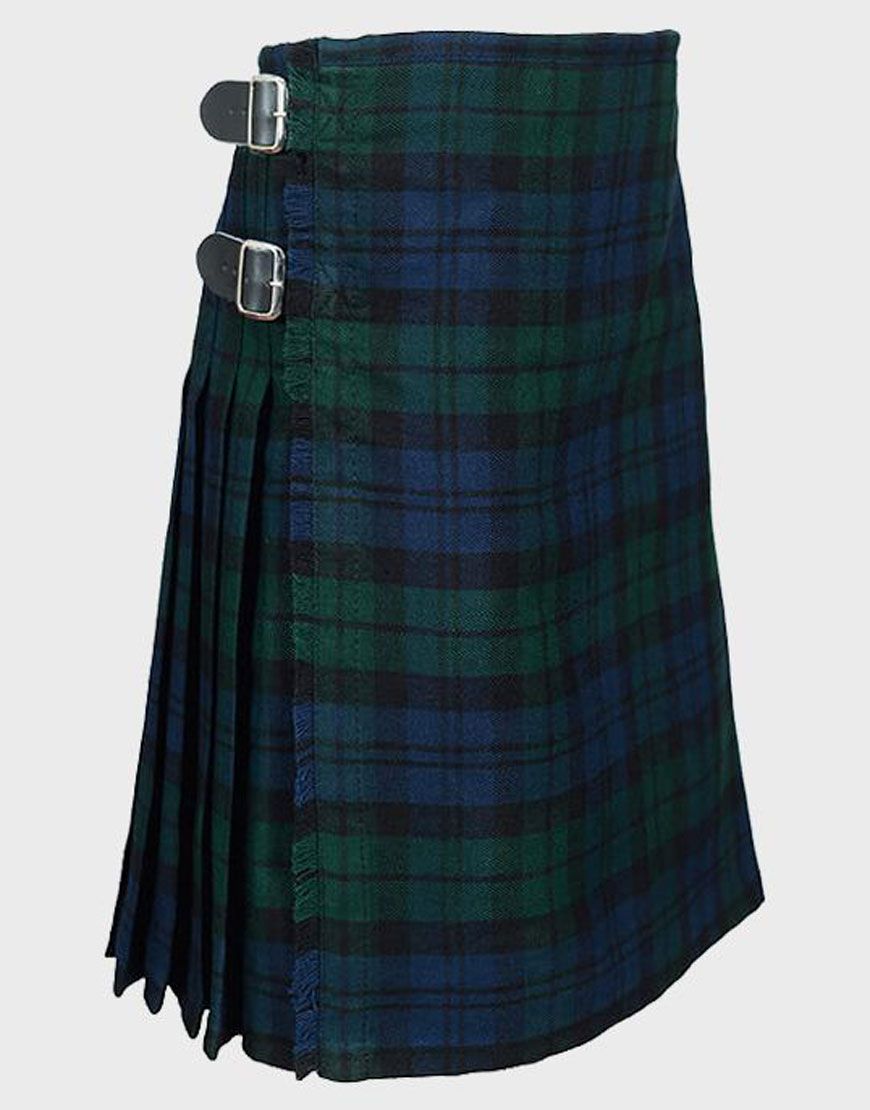
You can wear it with a plain shirt.
You can wear it with knitwear.
You can add a jacket later.
That versatility is especially useful at a literary festival, where the clothing should feel interesting but never theatrical.
Clan Tartan or Something More Personal?
Your surname does not have to decide the outfit
Some visitors may naturally choose a clan tartan.
If you have researched your family history and know that a particular sett has a genuine connection with your ancestry, wearing it at Wigtown can add another layer to the day.
After all, literature and genealogy frequently overlap. Family stories, local history, memoir, migration, and identity are common subjects at festivals like Wigtown.
But there is no requirement to wear a clan tartan.
District tartans may feel more appropriate if your connection is geographical rather than genealogical. Universal tartans work for anyone. Military tartans carry their own histories. Contemporary designs can reflect organisations or ideas rather than bloodlines.
Kiltist’s wider collection of kilts for men gives you room to compare different directions rather than beginning with the assumption that every kilt needs a clan surname attached to it.
Choose honestly.
That principle works just as well in literature as it does in clothing.
 Brown Hybrid Utility Kilt for Men – Grey Tartan Pleats & Adjustable FitSpecial Price $159.00 Regular Price $200.00
 Black Cotton Utility Kilt with Leather StrapsSpecial Price $70.00 Regular Price $120.00


Dress for Autumn in Dumfries and Galloway
Wigtown weather makes layering part of the outfit
The festival takes place in early autumn.
That alone should influence what you wear.
A mild afternoon can become a cool evening. Rain is possible. Wind across the surrounding countryside can make outdoor walks feel colder than the temperature suggests.
This is where a kilt works particularly well with layers.
A plain shirt beneath a sweater gives you an easy daytime combination. A wool or tweed jacket can add warmth later. A practical waterproof outer layer can sit over everything when necessary.
You do not need a formal Highland jacket simply because you are wearing tartan.
In fact, Wigtown is probably one of the best places to pair a traditional kilt with ordinary Scottish autumn clothing.
A navy knit.
A textured cardigan.
A tweed jacket.
A waxed coat.
A scarf in a restrained solid colour.
The result feels Scottish without looking as though you dressed for a wedding and accidentally wandered into a bookshop.
Why Tweed Works So Well With Tartan
Tweed and tartan have very different visual structures.
Tartan is organised through intersecting coloured stripes.
Tweed tends to rely more on texture and small-scale colour variation.
That difference allows them to work surprisingly well together.
A subdued tweed jacket over a tartan kilt can produce an especially appropriate Wigtown outfit. The combination feels rural, literary, and distinctly Scottish without becoming formal.
The key is contrast.
If the tartan is visually strong, choose a quieter tweed.
If the tartan is mostly dark and restrained, you have slightly more freedom in the jacket.
Avoid combining multiple large checks.
There is no prize for fitting the highest possible number of Scottish patterns into one outfit.
What Shirt Should You Wear?
Book festival style rewards restraint
A plain Oxford shirt works beautifully.
White, pale blue, cream, charcoal, or another muted colour can all be effective depending on the tartan.
For something more relaxed, a grandad-collar shirt can work well with a kilt and knitwear.
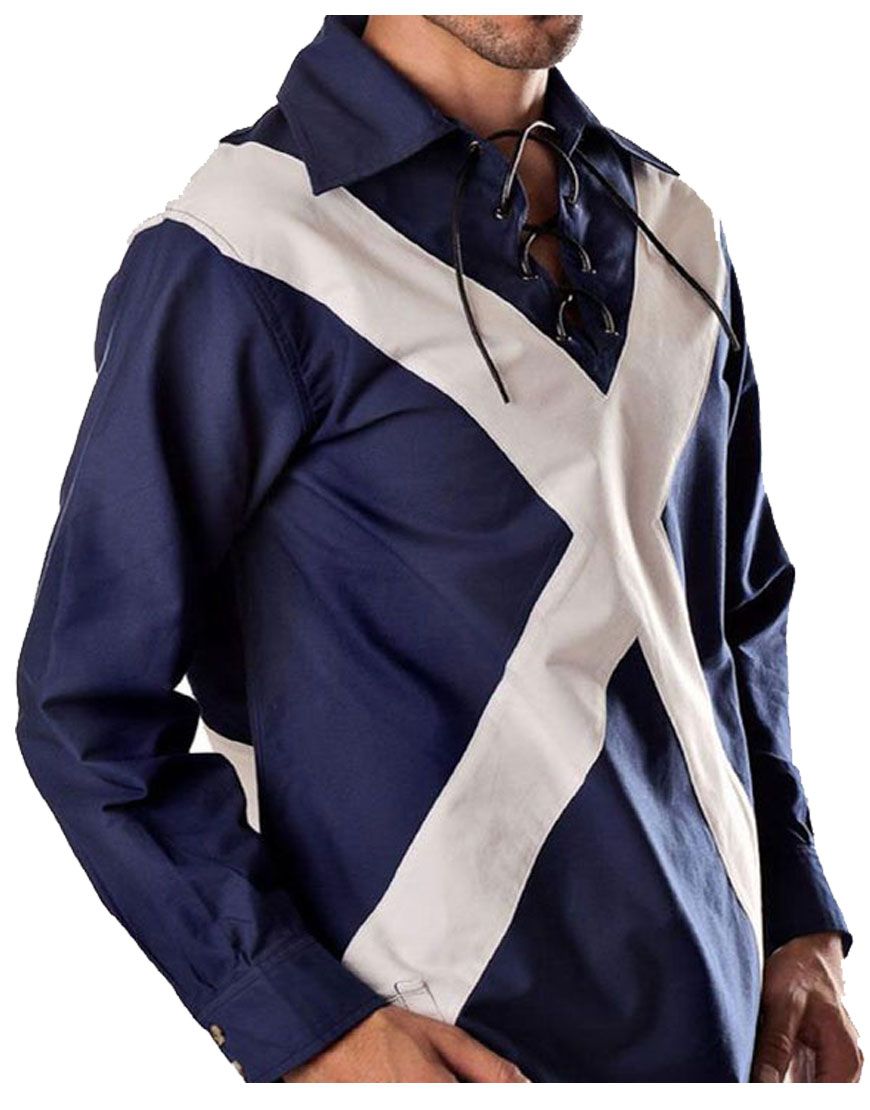
A ghillie shirt is another possibility if you want the outfit to lean more obviously toward Highland clothing, although it is not necessary for a literary setting.
The main rule is simple.
If the kilt contains the pattern, the shirt does not need one.
That lets tartan carry its cultural character without turning the entire outfit into a collection of competing checks.
The Sporran Still Makes Sense Among the Bookshops
A traditional kilt does not provide ordinary trouser pockets.
That makes a Scottish sporran useful even at a literary festival.
A leather day sporran is the obvious choice for Wigtown. It is practical, understated, and suitable for casual Highland dress.
But there is one limitation.
It will not carry the books you inevitably buy.


 Halloween Sporran with Ghost, Bat and Jack O'LanternSpecial Price $100.00 Regular Price $165.00


Wigtown’s status as Scotland’s National Book Town means browsing is part of the experience. The festival describes the town as having seventeen second-hand bookshops and related businesses, while its festival venues include a dedicated festival bookshop inside the County Buildings.
So use the sporran for your phone, wallet, tickets, and keys.
Carry a tote for the books.
Few outfits could look more appropriate in Wigtown than tartan accompanied by an increasingly heavy canvas bag full of Scottish history and second-hand novels.
Footwear Matters More Than Formality
You will spend a surprising amount of time walking
Wigtown is small, but festivals encourage constant movement.
A talk in one venue finishes.
You cross the square.
You browse a bookshop.
You walk to another event.
You stop for food.
Later, you return to the gardens or County Buildings for an evening session.
Traditional ghillie brogues can certainly work, particularly if you want a recognisably Highland outfit.
Ordinary leather brogues may be even easier.
Boots are another excellent choice for autumn, particularly if rain is forecast.
For Wigtown, practicality should determine the decision.
If the shoes work with the kilt and you can comfortably walk in them for hours, they are probably correct.
A Formal Highland Outfit Is Usually Too Much
Save Prince Charlie dress for occasions that actually require it
The Wigtown Book Festival is culturally significant, but it is not formal in the way a wedding reception, gala dinner, or black-tie event might be.
That means a full Prince Charlie outfit is usually unnecessary.
A jacket with silver buttons, waistcoat, bow tie, dress sporran, formal hose, and evening accessories can look excellent in the right environment.
Most daytime author talks are not that environment.
If you want a smarter kilt outfit, an Argyll jacket makes considerably more sense.
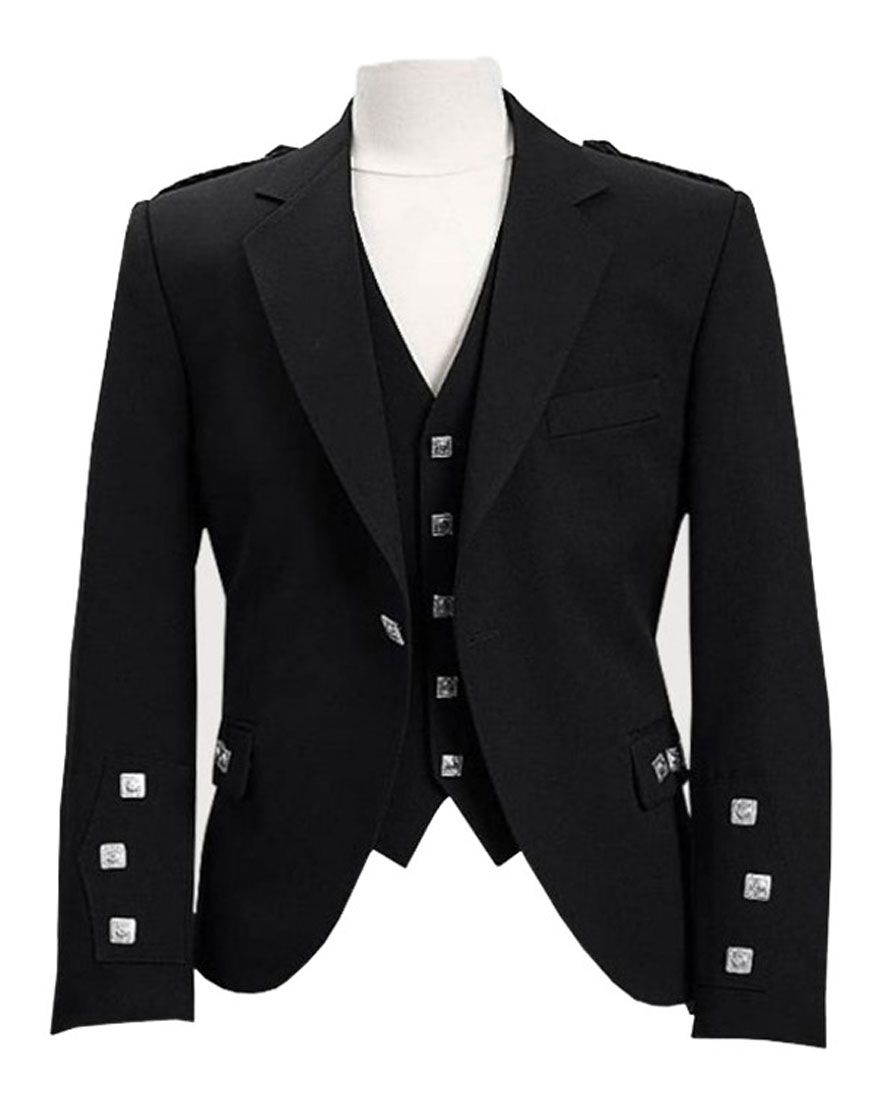
Its versatility allows you to wear it to a daytime event, dinner, reception, or evening performance without appearing excessively formal.
You could also ignore Highland tailoring entirely and wear tweed.
The kilt does not stop being traditional simply because the jacket above it comes from another part of the Scottish wardrobe.
Wigtown’s Opening Night Makes Tartan Especially Appropriate
There is one moment when the relationship between tartan and Wigtown becomes unusually direct.
The festival traditionally opens with a bagpipe procession through the town, followed by fireworks and a hog roast.
That opening immediately links the literary celebration with a recognisably Scottish public tradition.
The pipes do not turn Wigtown into a Highland Games.
They do something subtler.
They locate the festival.
Authors and audiences may arrive from around the world, but the event is taking place in Scotland, in a town whose cultural revival is tied specifically to its identity as Scotland’s National Book Town.
A kilt on opening night therefore feels particularly well placed.
Not because everyone needs to wear one.
Because the festival itself begins by reminding visitors where they are.
The 2026 Programme Makes Scottish Identity Especially Visible
Literature, local history, and contemporary culture overlap throughout the festival
The 2026 Wigtown Book Festival contains more than 250 events, including literature, poetry, film, theatre, podcasts, music, guided walks, and workshops. Its programme brings together local voices with major national and international names.
Among the 2026 guests is Scottish actor Bill Paterson, discussing stories drawn from his Glasgow childhood. The festival finale features Sam Heughan, who was born in Dumfries and Galloway and is appearing in connection with his writing, his attachment to Scotland, and his links with the region.
That mixture is characteristic of Wigtown.
The festival is international without abandoning its local setting.
A tartan kilt works in exactly the same way.
It is recognisably Scottish, but it does not prevent the wearer from participating in a modern, outward-looking cultural event.
The Literary History of Scotland Gives the Kilt Another Context
Scotland’s literary tradition is full of strong relationships with place and identity.
Robert Burns wrote in Scots and English while drawing heavily upon rural life, politics, song, love, and ordinary people.
Walter Scott helped shape nineteenth-century ideas of Scottish history and Highland identity, sometimes in ways historians would later complicate.
Robert Louis Stevenson carried Scottish themes across adventure fiction, poetry, travel writing, and psychological storytelling.
Later writers from Hugh MacDiarmid to Muriel Spark, Alasdair Gray, Nan Shepherd, Douglas Stuart, and countless contemporary voices continued changing what Scottish literature could sound like.
A kilt at Wigtown exists in that broader cultural company.
It does not need to represent one romantic image of Scotland.
Scottish culture has always contained contradictions: Highland and Lowland, Gaelic and Scots, rural and urban, traditional and experimental, local and international.
That complexity makes a literary festival one of the more interesting places to wear tartan.
Wearing Tartan Without Turning Yourself Into a Character
There is a difference between wearing a kilt and performing Scottishness.
Wigtown is probably a particularly good place to remember that distinction.
Do not add every possible accessory because you are attending a Scottish festival.
You probably do not need a fly plaid.
You do not need a ceremonial brooch.
You do not need a large dress sporran.
You certainly do not need military insignia or clan badges with which you have no legitimate connection.
A kilt, sweater, day sporran, hose, and good boots may look far more convincing.
The people around you are there to discuss ideas, books, history, politics, art, memory, place, and culture.
Your clothes can have cultural meaning without requiring an explanatory monologue.
Three Easy Wigtown Kilt Outfits
Think in terms of a literary autumn day
For the simplest combination, wear a dark tartan kilt with a plain Oxford shirt, leather day sporran, neutral hose, and brogues. Carry a lightweight waterproof layer.
For a more relaxed autumn outfit, combine the kilt with knitwear, boots, and a simple sporran. Add a scarf if the weather demands it.
For a smarter evening, introduce a tweed or Argyll jacket and keep the rest restrained.
All three allow the same kilt to move through the day.
That is important because Wigtown encourages wandering.
You might begin in a bookshop and finish at a theatre event without returning to your accommodation in between.
Your outfit should be capable of making the same journey.
Buy a Kilt Like You Buy a Good Book
Choose something you expect to return to
A kilt bought solely because one festival is approaching may spend too much of its life in a wardrobe.
Choose differently.
Look for a tartan that continues to interest you after the first impression.
Learn its background.
Think about its colours in different settings.
Imagine wearing it at another festival, a wedding, Burns Night, a ceilidh, or another Scottish cultural event.
Kiltist’s range of traditional tartan kilts can be approached in exactly that spirit.
You do not need the loudest cover on the shelf.
You need the one you will still want years later.
A good kilt, like a good book, becomes more valuable through repeated encounters.
Final Thoughts
Wigtown Book Festival shows that Scottish identity does not need to be confined to the most obvious traditions.
This is a town whose modern cultural importance grew from books. It became Scotland’s National Book Town in 1998, built a literary festival around that identity, and now draws thousands of people every autumn to a place with a permanent population of little more than a thousand.
The kilt fits into that story surprisingly well.
It is another Scottish tradition that survived by changing.
Wear it simply.
Choose a tartan you understand or genuinely appreciate. Pair it with clothes appropriate to an autumn day in Dumfries and Galloway. Carry a day sporran for the essentials and something larger for the books you will inevitably acquire.
Then move between readings, shops, conversations, and evening events without worrying too much about whether a kilt belongs at a literary festival.
In Wigtown, it does.
The books tell Scotland’s stories in words.
Tartan can quietly carry another part of the same story.